
FreeEarly game

Half-timbered houses, a tavern, a smithy, a village well and the castle that watches over them. Each medieval build comes with layer maps and a material list, so the dark oak frame ends up where it belongs.
Works with Java and Bedrock, on PC, console, phone and tablet. No mods needed.
From a market stall to a courtyard castle. Filter by difficulty and start with something small.


No builds with this difficulty here.
Missing a build? Request it
A timber house or the tavern gives the street its look. Both are medium builds with clear layers.
A smithy, a market stall and a well turn a row of houses into a village. They are small and quick to place.
Put a watchtower, a gatehouse or a castle on the hill. Stone bricks and dark roofs make the contrast with the timber below.
Medieval builds in Minecraft run on contrast. A stone base of cobblestone or stone bricks carries a light infill wall, and a dark oak frame of logs cuts it into panels. That is half-timbering. The Medieval Timber House is a clean example: dark oak logs, spruce planks and stairs, and calcite for the pale panels.
Roofs matter as much as walls. Spruce or dark oak stairs give a steep roof with a visible overhang, and a ridge one block higher than the slope looks more like a real gable. Leave the overhang. It casts the shadow under the eaves that makes the wall look deep.
Use more than one stone. Mix stone bricks with cracked and mossy variants, and a few cobblestone blocks low on the wall, so the stone looks old. On the layer map you can see exactly where each variant goes: click a material in the list and every block of it lights up.
The Medieval Timber House at the foundation, at mid height and at the roof. Open it to see every layer in between.
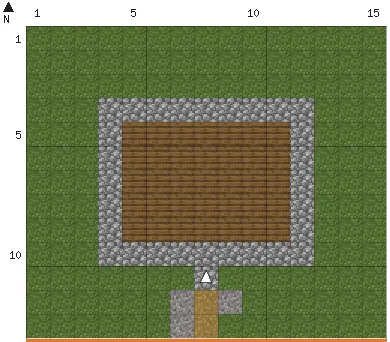
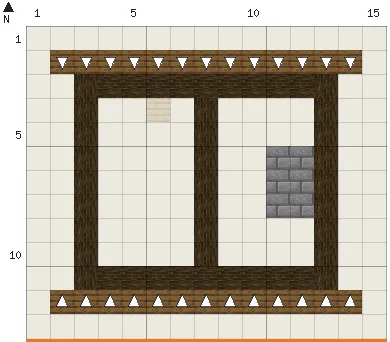
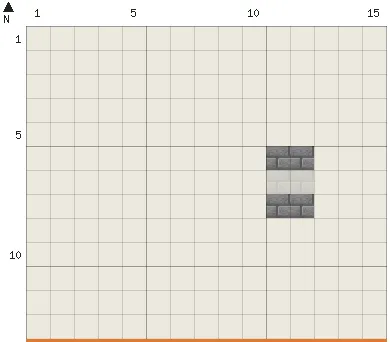
A medieval village needs variety in height and in use. The Medieval Tavern is the widest house, 20 blocks long, in dark oak and spruce with white terracotta panels. The Medieval Blacksmith is shorter and mostly stone, with spruce stairs and dark oak logs.
Castles scale the same ideas up. The Small Castle is free with every layer and uses stone bricks with cracked and mossy variants and dark oak stairs. The Castle Watchtower is only 11 blocks wide and 18 high, which makes it a fast first tower. Bigger projects, such as the Castle Keep and the Courtyard Castle, are Pro builds.
Plan the layout on paper first. Put houses along a street, the well in the open space, the smithy near the road and the tower at the edge. For more fortress ideas see the castle blueprints.
The Medieval Timber House, the Small Castle, the Castle Watchtower and the Village Well are free with every layer. Pro opens the rest.
$0
No account needed to start
$4.99 / month
Billed every month, cancel any time
$14.99 / year
$1.25 a month, billed once a year
Prices in US dollars. Payments are handled by Paddle. You can cancel in your account at any time.
Combine a stone base with pale panels and a dark oak frame, and add a steep roof of spruce or dark oak stairs with an overhang. Mix stone bricks with cracked and mossy variants so the stone looks old.
Dark oak logs for the frame, spruce planks and stairs, stone bricks or cobblestone for the base, and calcite or white terracotta for the panels. The material list of each build shows the full palette.
The Medieval Timber House, Small Castle, Castle Watchtower and Village Well are free with every layer. Other medieval builds show their first three layers and the full material list.
The Medieval Timber House is 15 × 13 blocks on the ground and 15 high. The Medieval Tavern is 20 × 17 and 15 high.
Yes. Combine houses, the tavern, a smithy, a market stall and a well, then add a watchtower or a castle. The build ideas page lists more.
Every build uses only blocks that exist in Minecraft Java Edition 1.20.1, so it also works in newer versions.